

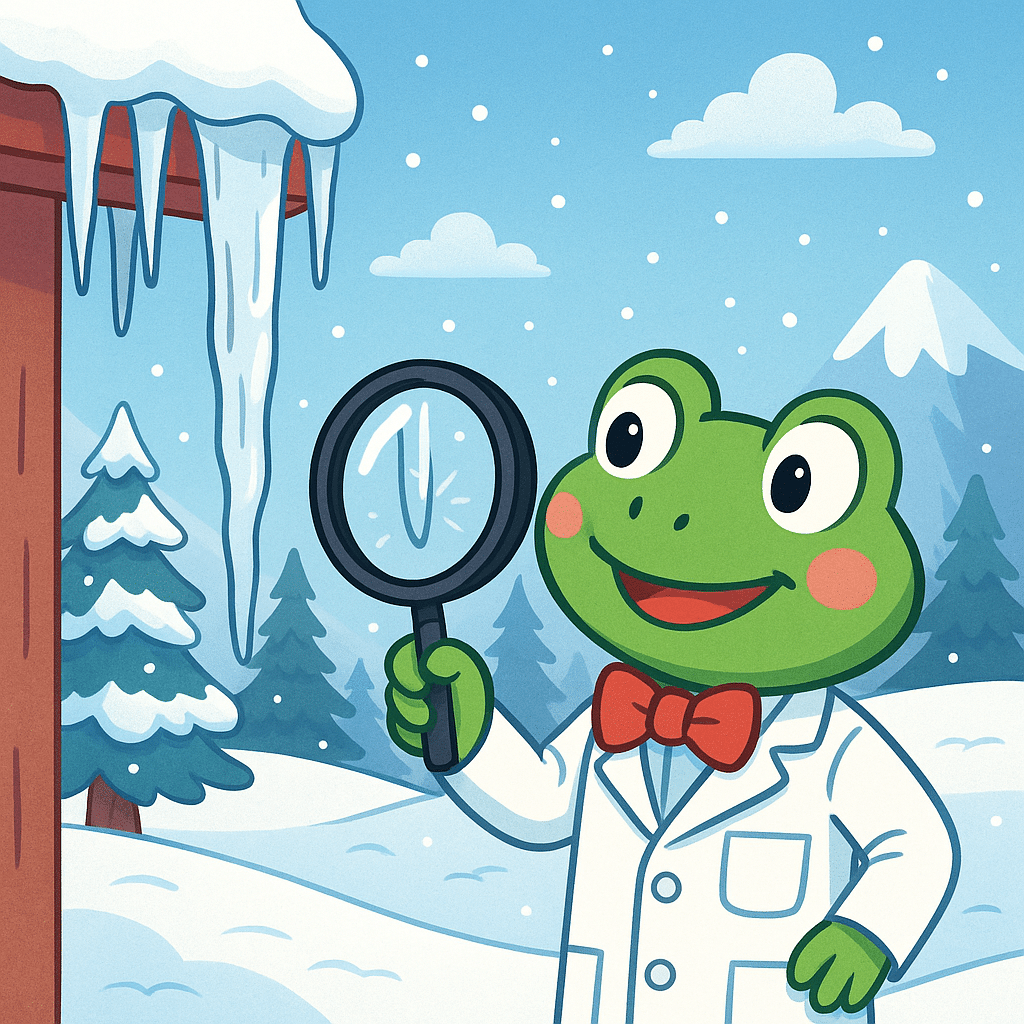
By Professor Bubbles — your frog scientist who loves sparkly winter science! 🐸✨
❄️ What Are Icicles?
You’ve probably seen icicles hanging from roofs, trees, fences or windows.
They look like frozen daggers, crystal spears, or magic winter decorations.
But how do they form?
And why do some winters have lots of icicles while others have almost none?
Let’s explore the icy science behind icicles with Professor Bubbles!
💧 Step 1: The Sun Melts Snow
It all begins with snow on a roof or branch.
Even in freezing temperatures, the sun can warm the snow just enough to melt a tiny bit.
This creates dripping water.
As the drops run off the edge, something cool happens…
❄️ Step 2: The Air Freezes the Drips
When the melted water reaches the cold air, it freezes instantly.
The first drops form a small bump of ice.
Every new drop adds another layer of ice…
…and another…
…and another…
Until a long, shiny icicle appears!
🔁 Step 3: Drip–Freeze Cycle
Icicles grow because of a repeating process:
- Snow melts
- Water drips
- Water freezes
- The icicle grows longer
This cycle can continue for hours or even days, making icicles:
- short and chunky
- long and thin
- twisted or smooth
- perfectly clear or cloudy
Each one is unique — just like snowflakes!
🌡️ Why Icicles Need “Just the Right Temperature”
For icicles to grow, the weather must be:
- Cold enough to freeze the drips
- Warm enough for snow to melt a little
This usually happens when temperatures are between –1°C and +2°C.
That’s why icicles often appear on:
- sunny winter days
- rooftops
- gutters
- tree branches
- rocky cliffs
Too warm? The water won’t freeze.
Too cold? Nothing melts.
Just right? Icicle time! ❄️✨
☀️ Why Icicles Sparkle
Icicles look magical because they bend and reflect sunlight like prisms.
The smoother the ice, the more it shines!
Some even glow yellow, blue, or pink depending on:
- time of day
- sunlight angle
- particles inside the ice
Nature’s glitter sticks!
⚠️ Are Icicles Dangerous?
Yes — sometimes!
Large icicles can be heavy and sharp.
They can break off roofs suddenly.
So always admire them from a safe distance!
“We love science — but we also love safety!”
— Professor Bubbles 🐸🦺
🧪 Winter Activity: Make Your Own Icicle (Indoors!)
You’ll Need:
- A plastic cup
- Water
- Food coloring
- Freezer
- A string or piece of yarn
Steps:
- Fill the cup with water + a drop of color.
- Dip the yarn into the water.
- Hang the yarn over the edge so it drips.
- Put the setup in the freezer.
- Check after 1 hour… 2 hours… 3 hours…
You’ll see the drips freeze downward — just like a real icicle!
🧠 Fun Icicle Facts
❄️ Icicles can grow up to 10 meters long on cliffs and caves.
❄️ “Frosticles” form when wind shapes the ice sideways.
❄️ Some icicles grow faster on the sunny side of a house.
❄️ Scientists study icicles to understand freezing patterns and even climate change.
📚 Science Vocabulary
| Word | Meaning |
|---|---|
| Icicle | A hanging spike of ice formed by dripping water that freezes. |
| Freeze | When liquid water turns solid because of cold temperature. |
| Melting | When solid ice becomes liquid water. |
| Cycle | A repeating process. |