

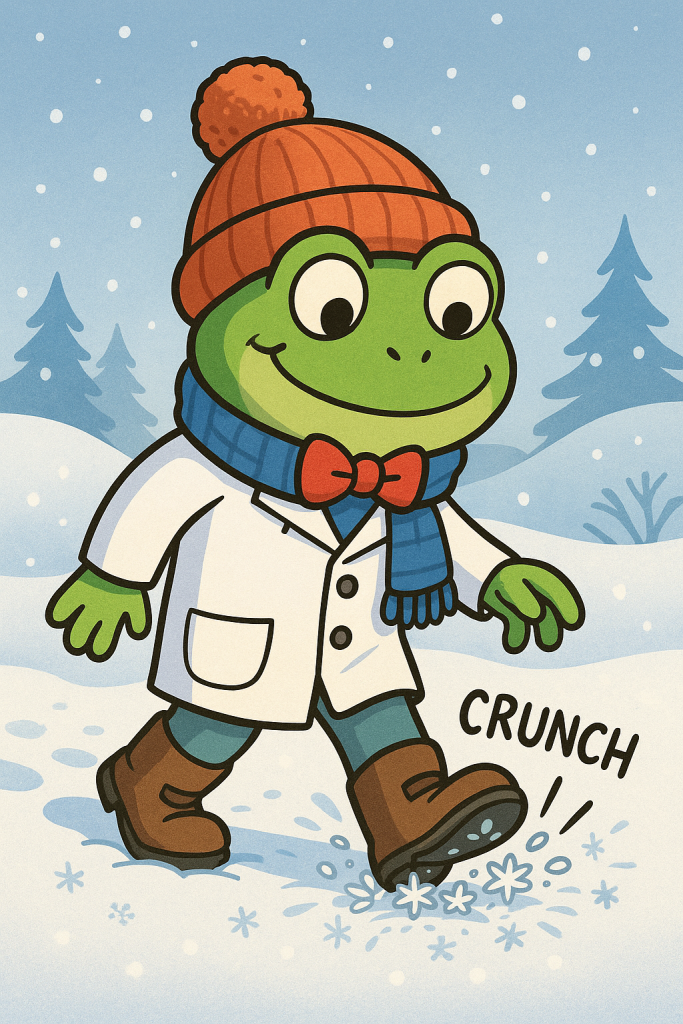
By Professor Bubbles — your frog scientist who LOVES crunchy snow walks! 🐸✨
👣 Crunch… crunch… crunch…
Have you ever walked across fresh snow and heard that satisfying crunch with every step?
It’s one of the most iconic winter sounds — but what causes it?
Why does some snow crunch loudly…
while other snow is soft and quiet?
Let’s explore the frozen science of snow sounds with Professor Bubbles!
❄️ Snow Is Made of Ice Crystals
Snow isn’t just cold dust — it’s made of tiny ice crystals, each with:
- sharp edges
- air spaces in between
- delicate shapes
Fresh snow is like a fluffy layer of frozen mini-stars.
When you step on it, something amazing happens…
💥 The Crunch = Breaking Crystals
When your boot presses down, it crushes thousands of ice crystals at once.
Breaking ice = sound.
So the crunch you hear is actually:
the sound of crystals shattering under pressure!
Imagine stepping on millions of tiny frozen glass sculptures — but safe and soft.
🌡️ Why Cold Snow Crunches More
Snow crunches loudest when the temperature is below –10°C (14°F).
Why?
Because the colder the snow, the harder and more brittle the crystals become.
Hard crystals = louder shatter = crunchy snow!
When snow is warmer:
- crystals soften
- edges melt slightly
- your steps become quiet and squishy
🌬️ Air Makes the Sound Louder
Snow contains lots of air pockets.
These tiny spaces amplify sound — like mini microphones.
When ice crystals break, the air helps carry the sound upward to your ears.
“Snow is basically nature’s giant speaker system!”
— Professor Bubbles 🐸🔊
🧊 Why Fresh Snow Crunches More Than Old Snow
Snow changes over time:
Fresh snow
❄️ sharp edges
❄️ lots of air
❄️ loud crunch
Old snow
🌨️ grains melt and refreeze
🌨️ crystals become rounded
🌨️ less air
🌨️ quieter steps
That’s why yesterday’s snow doesn’t always sound the same today.
👂 Winter Sound Science Experiment
Test how temperature changes the snow crunch!
You’ll Need:
- Fresh snow outdoors
- A thermometer
- Paper and pencil
Steps:
- Measure the outdoor temperature.
- Walk slowly on the snow.
- Rate the crunch from 1 (quiet) to 5 (super loud).
- Repeat the test on a warmer or colder day.
Kids quickly discover:
Colder = crunchier
Warmer = softer
Instant winter science!
🧠 Fun Facts from Professor Bubbles
❄️ The coldest crunch happens around –15°C.
❄️ Snow absorbs some sounds (that’s why the world is quieter after a snowfall).
❄️ Your footsteps can be heard farther in cold air because sound travels better in dense temperatures.
❄️ Animals use crunchy snow sounds to detect predators!
📚 Science Vocabulary
| Word | Meaning |
|---|---|
| Crystal | A solid with a geometric structure — snowflakes are crystals. |
| Pressure | Force applied to something (like stepping on snow). |
| Amplify | Make sound louder. |
| Brittle | Hard but easy to break. |