

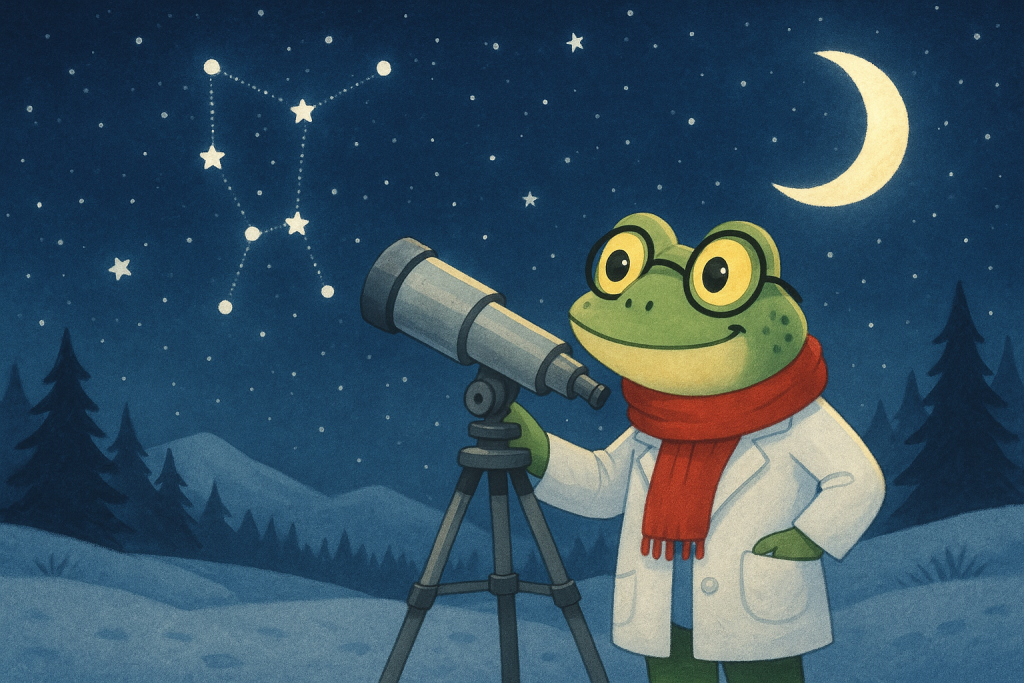
By Professor Bubbles — your frog scientist who loves stargazing in the snow! 🐸🔭❄️
🌌 Winter Nights = Nature’s Biggest Light Show
Winter may be cold, but it brings something magical:
the clearest, darkest, most beautiful skies of the year!
If you’ve ever looked up on a winter evening, you might notice:
- ⭐ Brighter stars
- 🌙 A glowing, crisp Moon
- 🌌 A sky that feels deeper and darker
- ✨ More constellations
But why does the winter sky look so different?
Let’s explore the science of winter stargazing with Professor Bubbles!
❄️ Why the Stars Look Brighter in Winter
There are three big reasons why stars shine more intensely in winter:
1. Cold Air = Clearer Air
Cold air holds less moisture than warm air.
Less moisture means:
- Less haze
- Less distortion
- Sharper, brighter stars
It’s like wiping fog off a window — suddenly you see everything clearly.
2. Longer Nights
In winter, nights can last 15–17 hours in some countries.
More darkness = more stargazing time! 🌙
3. Earth’s Position in Space
During winter, Earth faces a region of the galaxy with many bright stars, like:
- Orion (the Hunter)
- Taurus (the Bull)
- Gemini (the Twins)
These constellations light up the winter sky like jewels.
🌙 Why the Moon Looks Extra Bright in Winter
Have you ever noticed the Moon seems brighter when snow is on the ground?
That’s because of albedo — a science word meaning how much light a surface reflects.
White snow reflects tons of moonlight, making nights glow softly.
“Snow works like a giant natural mirror — perfect for moonlit adventures!”
— Professor Bubbles 🐸✨
🔭 Winter Constellations Kids Can Spot
Here are some easy constellations for children to find:
⭐ Orion
Look for three bright stars in a row — that’s his belt!
⭐ Taurus
A “V” shape of stars forming the bull’s face.
⭐ Cassiopeia
A zig-zag that looks like a big “W” in the sky.
⭐ The Pleiades
A tiny cluster of twinkling blue stars — like a cosmic snowflake.
Winter is full of some of the brightest stars in the entire sky.
🧪 Winter Night Activity: Make a Constellation Viewer!
You’ll Need:
- A cardboard tube
- Tinfoil
- Toothpick
- Rubber band
- Flashlight
Steps:
- Cut a circle of tinfoil to cover the tube.
- Draw a simple constellation (like Orion).
- Poke holes along the star dots.
- Attach the foil to the tube.
- Shine a flashlight through it onto a dark wall.
You’ll project your own indoor constellation! 🌟
🧠 Fun Winter Sky Facts
❄️ Winter air can make the stars “twinkle” more because of temperature layers.
🌙 Snow reflects up to 90% of moonlight!
✨ The winter sky includes some of the brightest stars in the universe — like Sirius.
🪐 Planets like Jupiter and Mars look sharper in cold skies.
📚 Science Vocabulary
| Word | Meaning |
|---|---|
| Constellation | A pattern of stars forming a shape. |
| Albedo | How much light a surface reflects. |
| Atmosphere | The air around Earth. |
| Moisture | Water in the air (humidity). |