

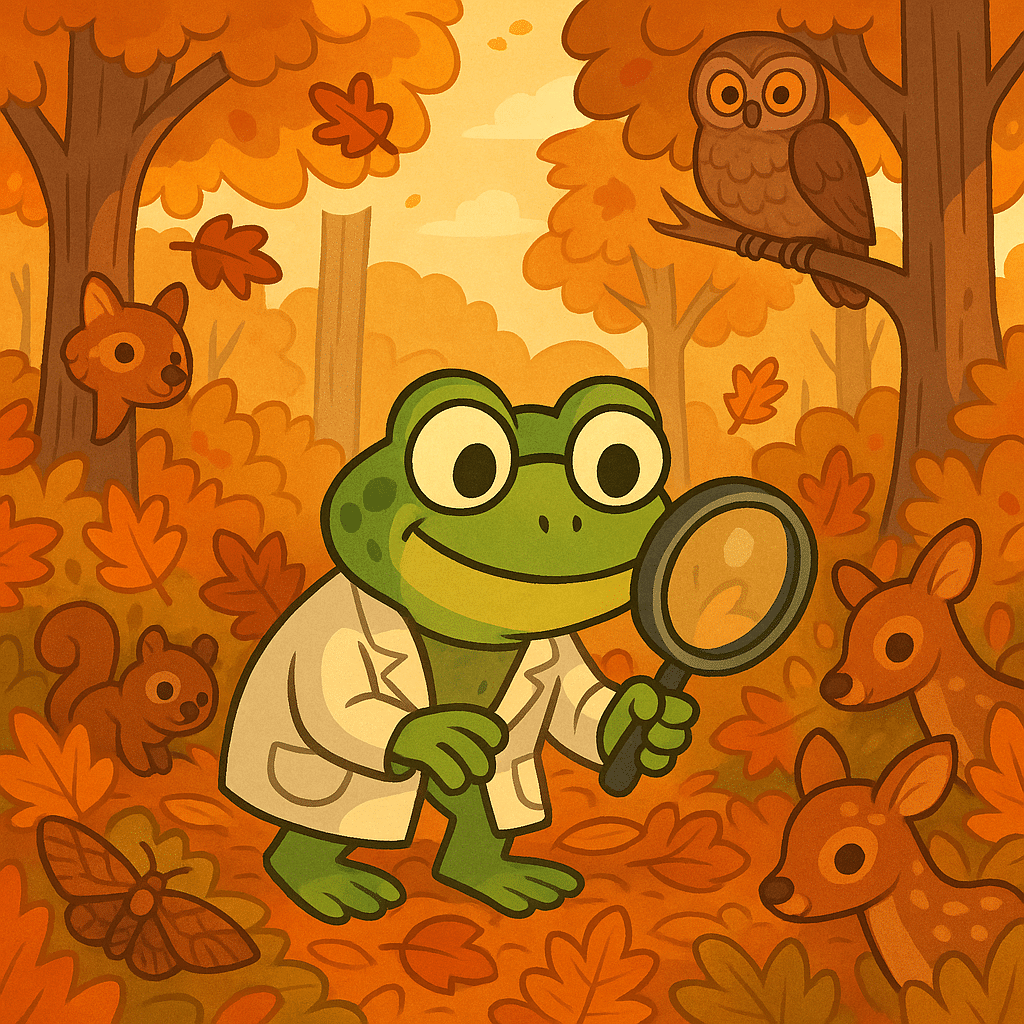
Written by Professor Bubbles — your frog scientist who’s excellent at hiding in leaves! 🐸🍁
🎨 What Is Camouflage?
Camouflage is nature’s version of hide-and-seek.
It helps animals blend into their surroundings so predators can’t find them — or so they can sneak up on food!
In the wild, being invisible can mean the difference between catching dinner or becoming dinner.
“Camouflage is nature’s superhero power — and animals use it brilliantly!”
— Professor Bubbles 🐸✨
🍁 Why Autumn Changes the Camouflage Game
Autumn transforms forests into worlds of orange, yellow, brown, and red.
For animals, this means they need new colors, new hiding places, and new strategies.
Some animals stay still.
Some change their fur color.
Some even grow new patterns!
Let’s explore how animals become masters of disguise in autumn.
🐿️ Squirrels: Masters of Brown and Grey
Squirrels blend perfectly with:
- Tree bark
- Dry leaves
- Branches
- The forest floor
Their fluffy brown and grey fur makes them nearly invisible as they gather acorns for winter.
If you spot a squirrel… you’re lucky.
It probably saw YOU first!
🦊 Foxes: The Autumn Ninjas
Red foxes have warm orange-red coats that match:
🍁 Fallen leaves
🪵 Forest logs
🌾 Dry grass
In autumn, foxes are almost invisible while hunting mice and rabbits.
Their bushy tails help them balance as they sneak through forests like silent spies.
🦉 Owls: The Perfect Tree Trunks
Owls are nighttime hunters, but even during the day they stay hidden.
Their feathers mimic:
- Bark patterns
- Tree hollows
- Mossy branches
Some owls even tilt their bodies to blend into the shape of a branch.
They become living tree decorations!
🦌 Deer: Blending With the Forest
Deer have tan-brown fur that matches autumn landscapes perfectly.
Their camouflage helps them stay safe from predators — especially when they freeze and stand perfectly still.
If a deer doesn’t move, it becomes part of the forest.
🦋 Moths: The Hidden Butterflies
Many moths rest on trees in autumn.
Their wings look exactly like:
- Tree bark
- Lichen
- Stones
- Fallen leaves
Some even have fake eye spots to scare predators!
🧠 Science Behind Camouflage
Animals use three main types of camouflage:
🎨 1. Color Matching
Blending in with the environment.
(e.g., squirrels, deer)
📐 2. Pattern Matching
Using stripes, spots, or speckles.
(e.g., owls, moths)
🪞 3. Disruptive Coloration
Patterns that break up the body shape so predators can’t recognize it.
(e.g., foxes blending with autumn shadows)
🌿 BONUS: Seasonal Camouflage
Some animals change color with the seasons — like Arctic hares and stoats!
“Camouflage is all about tricking the eye. Even mine — and I’m a scientist!”
— Professor Bubbles 🐸👓
🧪 Try This Fun Autumn Activity
Camouflage Challenge: Can You Hide Like an Animal?
You’ll Need:
- Paper
- Markers
- Leaves
- Sticks
- Tape
Steps:
- Draw a simple animal: a frog, squirrel, or moth.
- Color it to match your backyard or garden.
- Place it somewhere outside.
- Ask someone to find it!
This teaches kids how color and pattern science works in the real world.
🧠 Fun Facts
🦊 Foxes’ fur looks red to humans, but to many animals (who see fewer colors), it blends perfectly with trees.
🦌 Deer fawns have spots like sunlight filtering through leaves — perfect camouflage!
🦉 Owls can change posture to match tree shapes.
🐸 Some frogs change color slightly with temperature — including Professor Bubbles!
📚 Science Vocabulary
| Word | Meaning |
|---|---|
| Camouflage | The ability to blend into surroundings. |
| Predator | An animal that hunts others. |
| Prey | An animal that is hunted. |
| Disguise | A way to hide or look different. |