

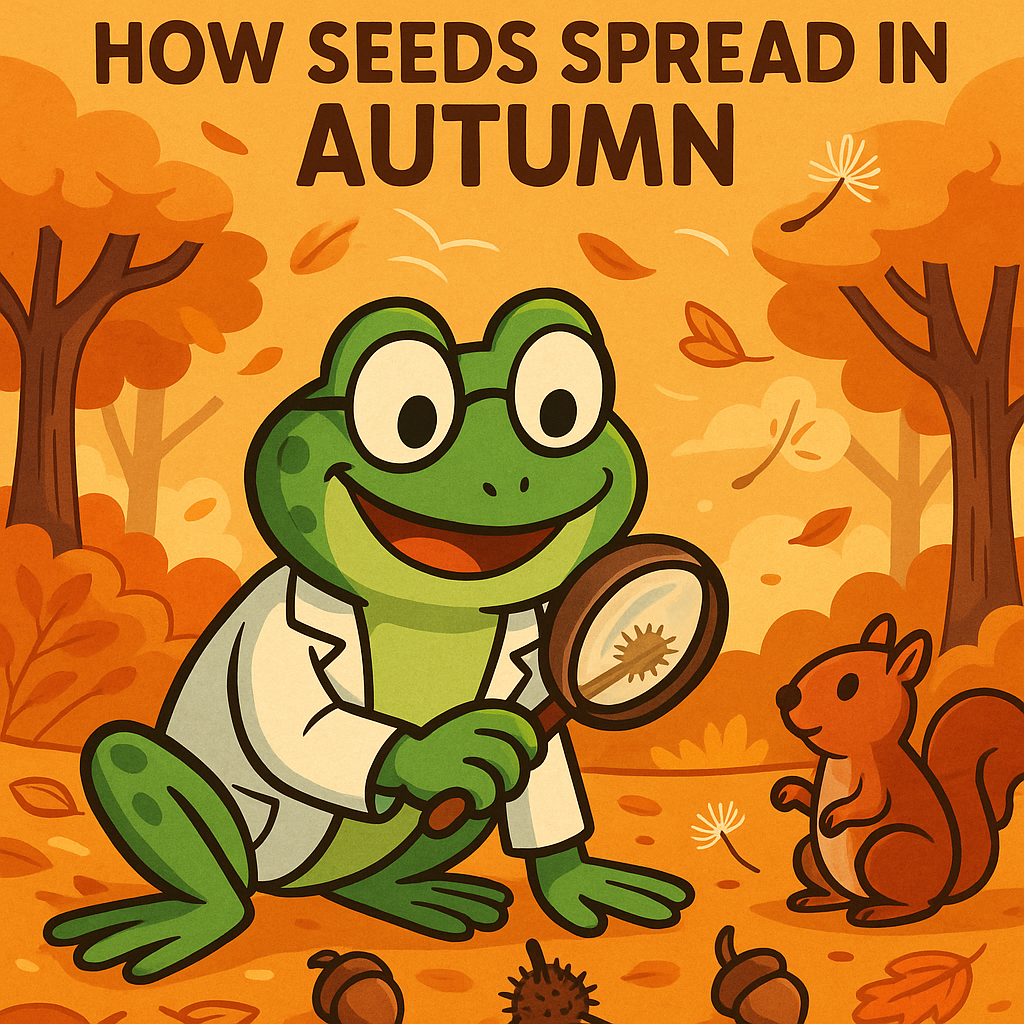
By Professor Bubbles, your frog scientist who loves watching the wind carry nature’s secrets! 🐸🍃
🍁 Autumn: The Season of Seed Adventures
When the air turns cool and leaves start to fall, something magical happens in nature — plants send their seeds out on adventures! 🌬️
Autumn isn’t just about colorful leaves and pumpkins — it’s the time when plants prepare for the next generation of life. Every seed has one big mission:
“Find a new home where it can grow!” 🌱
Let’s follow Professor Bubbles through the forest and fields to discover how seeds travel in amazing ways!
🌬️ 1. Flying Seeds: Carried by the Wind
Some seeds are so light that they can float through the air like tiny parachutes.
Have you ever blown on a dandelion puff and watched the white seeds fly away? That’s nature’s clever design at work!
Wind travelers include:
- 🌼 Dandelions – tiny parachutes that float far away.
- 🌳 Maples – seeds shaped like helicopters that spin to the ground.
- 🍂 Poplars and willows – fluffy cotton-like seeds that drift for miles.
Professor Bubbles says:
“When seeds fly, they’re exploring the world — just like little adventurers with wings!” ✈️
🐿️ 2. Hitchhiker Seeds: Sticking to Fur and Clothes
Some seeds don’t fly — they hitch a ride!
Their trick? Tiny hooks or sticky surfaces that grab onto fur, feathers, or even your socks!
If you’ve ever found little burrs stuck to your clothes after a walk, you’ve met these clever travelers.
Examples of hitchhiker seeds:
- 🌿 Burdock – has tiny hooks that cling like Velcro.
- 🌾 Goosegrass – sticks to anything passing by.
- 🐾 Clover – travels on animal fur and paws.
Fun fact: The inventor of Velcro got his idea from looking at burdock seeds under a microscope!
🐦 3. Hungry Helpers: Seeds Eaten by Animals
Many plants let animals do the hard work of traveling.
They make their seeds tasty and hide them inside fruits! 🍎🐿️
When animals eat fruits, the seeds pass through their digestive system and are dropped somewhere new — often with a bit of fertilizer (💩) to help them grow!
Examples:
- 🍓 Birds eat berries and spread the seeds in new areas.
- 🐻 Bears love apples and wild fruits — they help forests grow!
- 🐿️ Squirrels bury nuts and acorns for winter, but forget some — new trees sprout where they’re buried!
🌊 4. Water Travelers: Floating to New Homes
Some seeds can float on rivers or ponds until they find new soil to grow in.
- 🌴 Coconut seeds can float across oceans!
- 🌿 Water lilies spread across lakes and ponds.
- 🌾 Mangroves drop seeds that drift on waves before planting themselves in soft mud.
Professor Bubbles says:
“Seeds that float are like tiny boats sailing to their next adventure!” 🌊🚤
🔬 The Science of Seed Dispersal
This process of spreading seeds is called dispersal.
It helps plants:
- Avoid growing too close to the parent tree.
- Find new sunlight, space, and soil.
- Keep forests and fields full of life! 🌳🌾🌻
Without dispersal, plants would compete for food and sunlight — and nature would be a very crowded place!
🧪 Try This Fun Autumn Activity!
Make Your Own Seed Explorer!
What You’ll Need:
- A small notebook or paper
- Pencil or crayons
- A magnifying glass 🔍
- A paper bag or basket
Steps:
- Go on a walk with an adult in a park or forest.
- Collect seeds, nuts, or burrs you find on the ground.
- Use your magnifying glass to study their shape.
- Ask: How do you think this seed travels?
- By wind? 🪁
- By animals? 🐿️
- By water? 🌊
- Draw or label each seed in your notebook.
🧠 Fun Facts from Professor Bubbles
🍂 A single dandelion can send over 100 seeds into the wind!
🐦 Some birds can carry seeds over hundreds of miles before dropping them.
🌰 An oak tree can grow from one acorn — and live for over 1,000 years!
🌿 Some plants even make seeds that pop open and shoot out when touched!
📚 Science Vocabulary
| Word | Meaning |
|---|---|
| Dispersal | The spreading of seeds away from the parent plant. |
| Germination | When a seed starts growing into a plant. |
| Burr | A sticky seed that clings to fur or clothes. |
| Embryo | The baby plant inside a seed. |