

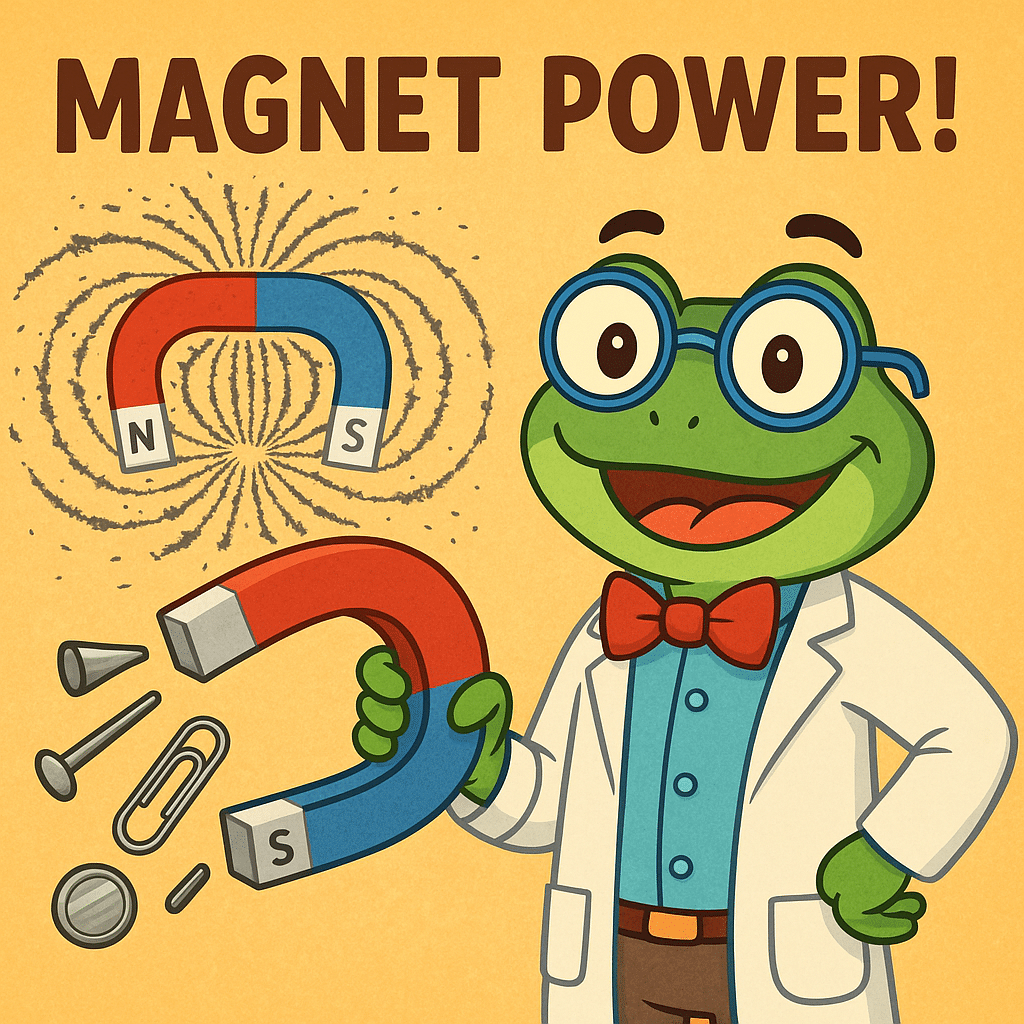
Have you ever seen a paperclip jump without anyone touching it? That’s not magic — it’s magnetism!
Magnets are all around us: in toys, phones, computers, and even inside the Earth itself!
Today, Professor Bubbles will show you how to explore this invisible force through fun, hands-on science experiments you can do at home or in class.
🧪 What You’ll Need
To begin your magnetic adventure, gather these simple materials:
- 1 magnet (a bar magnet or a fridge magnet works great)
- Paperclips, nails, and coins
- A few non-metal objects like wood, rubber, or plastic
- A piece of paper
- Some iron filings (or sand with tiny metal bits)
- A compass (optional)
🔬 Step-by-Step Instructions
1. Test What Sticks
Place your magnet on a table and try different objects. Which ones are attracted? Which ones aren’t?
👉 Metals like iron and steel will stick — but wood and plastic will not.
2. Make a Prediction
Before testing each object, guess whether it will be magnetic or not. Great scientists always predict first!
3. Reveal the Invisible Field
Lay a piece of paper on top of your magnet. Gently sprinkle iron filings on top.
You’ll see the filings arrange themselves into curved lines — that’s the magnetic field!
4. Find the Poles
Try using both ends of your magnet. One side is the north pole, the other is the south pole.
Two north poles push apart, two south poles push apart — but a north and south pole pull together!
🧠 The Science Behind It
Magnets create invisible magnetic fields — regions where magnetic forces can push or pull.
- Every magnet has two poles: north and south.
- Magnetic field lines travel from the north pole to the south pole.
- The Earth itself is one giant magnet! That’s how compasses point north.
- Some metals, like iron, nickel, and cobalt, are magnetic because of how their atoms align.
Professor Bubbles explains:
“Magnets may be invisible, but they’re mighty! Every time your compass moves or your fridge holds up a drawing — that’s magnetism in action!”
🧩 Try These Fun Variations!
- 🧲 Magnet Race: Use two magnets to race paperclips across the table.
- 🐟 Magnetic Fishing Game: Make cardboard fish with paperclips and “catch” them using a magnet tied to string.
- 🌀 Magnet Maze: Tape a maze on cardboard and guide a metal ball through it using a magnet underneath.
- 🌍 Find Earth’s Magnetism: Place a magnetized needle in water — it’ll turn north, just like a compass!
📓 Observation Journal
Keep a Magnet Journal where you record your discoveries!
You can include:
- Which materials were magnetic
- How far away the magnet worked
- The shapes of your magnetic field lines
- Drawings of your experiments
Professor Bubbles says:
“The best scientists are careful observers — write it, sketch it, and share it!”
🧩 Key Science Vocabulary
| Word | Meaning |
|---|---|
| Magnet | An object that can attract certain metals like iron or steel. |
| Magnetic field | The invisible area of force around a magnet. |
| Poles | The ends of a magnet — one north, one south. |
| Attract / Repel | “Attract” means pull together, “repel” means push apart. |