

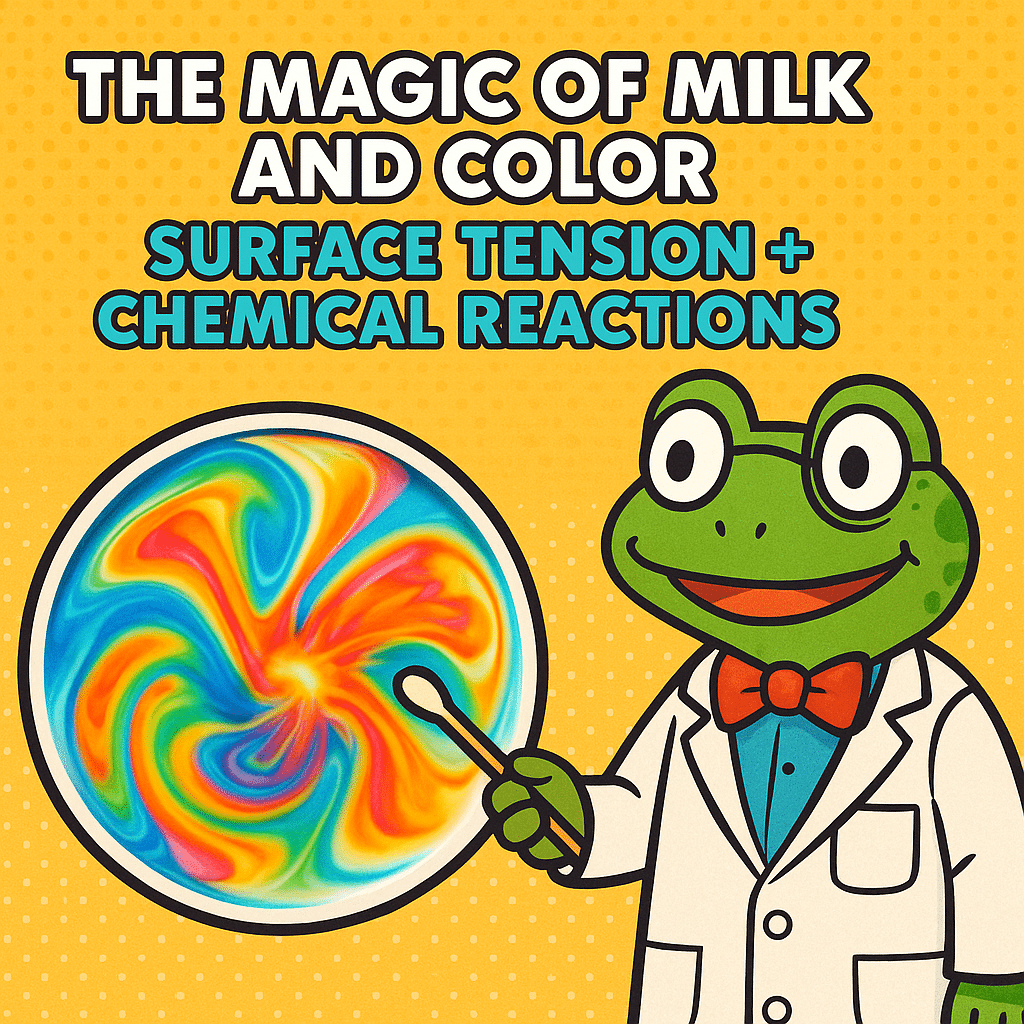
By Professor Bubbles, the frog scientist with a splash of style! 🐸✨
🌈 Watch Colors Dance in Milk!
What happens when you mix milk, food coloring, and a drop of dish soap?
You get a color explosion that swirls and spins like magic! But it’s not just magic — it’s science! This fun, easy experiment shows how surface tension and molecules work together.
Grab your science goggles and join Professor Bubbles as we explore the science behind these rainbow reactions. 🧪🌈
🧂 What You’ll Need
You only need a few simple kitchen ingredients to make this colorful reaction happen:
- 1 shallow dish or plate
- Some milk (whole milk works best!)
- Food coloring in different colors
- A few drops of liquid dish soap
- A cotton swab or toothpick
Optional: paper towels (for any splashes!)
🔬 Step-by-Step Instructions
- Pour the milk
Pour a thin layer of milk into your dish — just enough to cover the bottom. - Add the colors
Drop small dots of food coloring on the surface. Use multiple colors for a fun effect! - Prepare your “magic wand”
Dip the end of your cotton swab into the dish soap. - Touch the surface
Gently touch the middle of the milk with your soapy swab — and watch what happens! 💥
The colors will burst apart and swirl around like fireworks in slow motion. - Keep experimenting
Try touching different spots or adding more soap — every reaction looks different!
🧠 The Science Behind the Magic
This colorful reaction happens because of something called surface tension.
- Milk is mostly water, but it also contains fats and proteins.
- These molecules like to stick together, creating a kind of “skin” on the surface.
- When you add soap, it breaks apart this surface tension.
- The soap molecules race around to mix with the fats — and this motion makes the colors swirl!
So what looks like magic is actually a chemical reaction between soap and fat molecules.
Professor Bubbles says:
“Science is full of hidden dances — you just need the right light to see them!” 🌟
🌈 Try These Fun Variations
- 🥛 Compare different milks — whole, skim, oat, or soy milk. Which gives the biggest reaction?
- 💧 Add salt or sugar to see if it changes the motion.
- ☀️ Warm vs. cold milk: Does temperature make the colors move faster?
- 📸 Slow-motion video: Record it with your phone to see the color waves in detail!
🧾 Observation Time
Keep track of what you notice in your Color Explosion Journal!
- How fast do the colors move?
- Do they mix evenly or form patterns?
- Does one color move more than the others?
- What happens when the soap spreads everywhere?
Draw what you see and label the color movements — it’s like being a scientist and an artist at the same time! 🎨🔬