

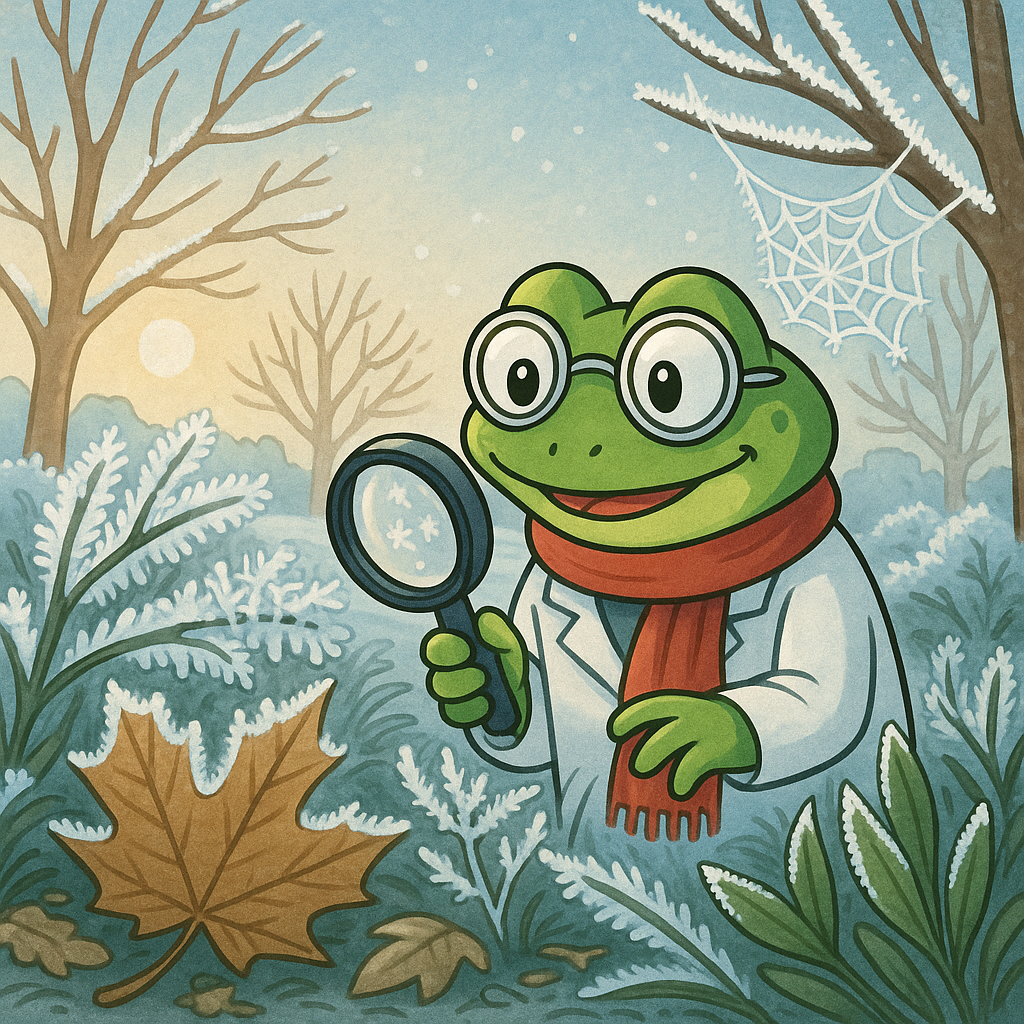
By Professor Bubbles — your frog scientist who wakes up early to study sparkly things! 🐸🔬
✨ A Magical Winter Morning
Have you ever stepped outside on a cold morning and seen the world covered in a thin layer of white, sparkly ice?
Grass looks fluffy.
Trees look dusted with diamonds.
Cars look like they’re coated in sugar.
That is hoarfrost — a natural winter decoration created by nothing but cold air and water vapor.
But how does hoarfrost form? And why does it look so different from snow or regular frost?
Let’s explore this beautiful winter science with Professor Bubbles! ❄️👀
❄️ What Exactly Is Hoarfrost?
Hoarfrost is a type of ice crystal that forms directly on surfaces, like:
- grass
- leaves
- fences
- rooftops
- spiderwebs (these are extra magical!)
It looks like clusters of tiny white feathers, needles, or crystals.
Think of it as winter’s version of glitter — made by nature!
🌬️ Hoarfrost Forms When Water Vapor Turns Into Ice
Here’s the cool part:
Hoarfrost does not start as liquid water.
It forms when water vapor in the air (tiny water particles you can’t see) touches something VERY cold and turns straight into ice.
This process is called deposition — when a gas becomes solid without becoming a liquid first.
“Hoarfrost is science’s shortcut: vapor → ice, no melting needed!”
— Professor Bubbles 🐸✨
🌡️ What Conditions Make Hoarfrost?
Hoarfrost only forms when all three of these conditions happen:
1. Clear skies at night
This lets the ground lose heat, making surfaces super cold.
2. Very cold air
Usually below 0°C (32°F).
3. Moisture in the air
Not too much — just enough for vapor to freeze instantly.
When these match perfectly, winter starts decorating the world with icy art.
🌿 Why Hoarfrost Looks Like Feathers or Needles
Unlike regular frost, hoarfrost forms large, pointed crystals because:
- it grows outward into the open air
- each new crystal builds on the last
- cold air allows slow, beautiful crystal growth
This creates shapes that look like:
✨ feathers
✨ spikes
✨ white fur
✨ crystal branches
Every surface becomes a canvas for winter geometry.
❄️ Hoarfrost vs. Regular Frost vs. Snow
Kids often confuse these — here’s the difference:
| Winter Thing | How It Forms | What It Looks Like |
|---|---|---|
| Hoarfrost | vapor freezes directly into ice | feather-like crystals |
| Regular frost | dew freezes | thin, flat ice film |
| Snow | ice crystals form in clouds | flakes fall from sky |
Hoarfrost is the only one that grows on the surface like tiny frozen plants.
🧪 Winter Science Activity: “Find the Frost Shapes!”
Go outside early on a cold morning and look for hoarfrost.
Look closely at:
- leaves
- grass
- wooden fences
- car windows
- spiderwebs (they look incredible!)
Try to see if the crystals look like:
- needles
- feathers
- branches
- stars
Take photos or draw what you see!
“Every hoarfrost crystal is a mini science experiment happening right before your eyes.”
— Professor Bubbles
🧠 Fun Hoarfrost Facts
❄️ Hoarfrost can grow several centimeters long during very cold, calm nights.
❄️ Animals sometimes lose their footprints in hoarfrost because it forms so delicately.
❄️ Viking sailors used hoarfrost to predict weather changes.
❄️ Hoarfrost on trees can make entire forests look silver and glowing!
📚 Science Vocabulary
| Word | Meaning |
|---|---|
| Hoarfrost | Feathery ice crystals that form on cold surfaces from water vapor. |
| Deposition | When a gas turns directly into a solid. |
| Vapor | Water in its gaseous form. |
| Crystal | A solid with a repeating geometric structure. |