

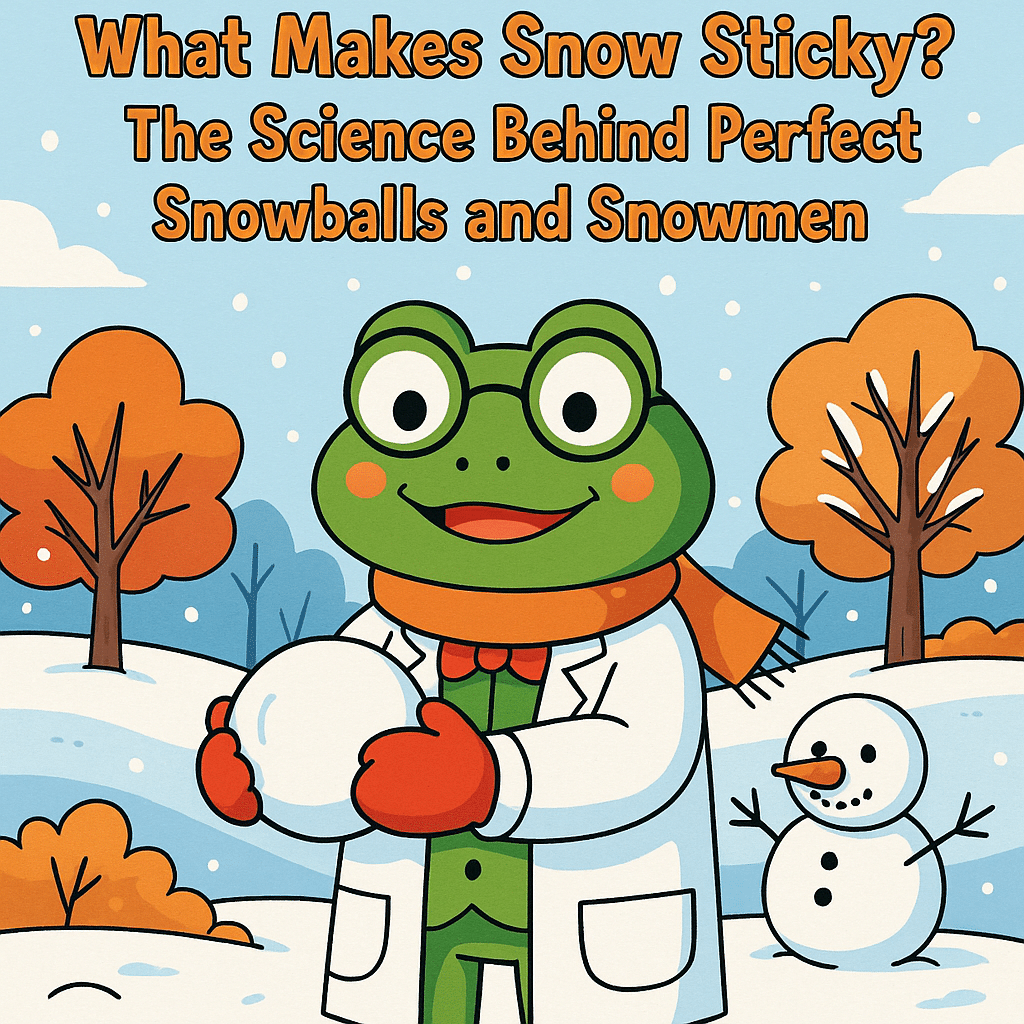
By Professor Bubbles — your frog scientist who builds the BEST snowballs in the forest! 🐸🧤✨
❄️ Not All Snow Is the Same
Have you ever noticed that sometimes snow is soft and powdery…
and other times it’s sticky enough to make the perfect snowball or snowman?
Kids always wonder:
Why does some snow clump together while other snow falls apart?
Spoiler: It’s all about temperature, crystal structure, and water content.
Let’s explore snow stickiness with Professor Bubbles!
🌡️ Temperature Controls Everything
Snow becomes sticky when the temperature is just below freezing, around:
–1°C to –3°C (30°F to 28°F)
In this range:
- The snow crystals start to melt slightly on the outside
- That thin layer of water acts like glue
- When you press the snow together, it refreezes, sticking the snow firmly
This creates the perfect snowball-making texture!
“Warm enough for stickiness, cold enough to hold its shape — the magical middle zone!”
— Professor Bubbles 🐸❄️
🧊 Why Powder Snow Doesn’t Stick
When the temperature is very cold — below –7°C (19°F) — snow becomes:
- dry
- powdery
- hard to shape
- useless for snowballs ☹️
The crystals are too cold to melt at all.
No melting = no stickiness.
No stickiness = no snowman.
That’s why Arctic snow rarely forms snowballs — it’s just too cold!
❄️ Snow Crystal Shapes Matter Too
Snowflakes come in many shapes:
- stars
- plates
- needles
- columns
- dendrites
Sticky snow usually contains dendrites — snowflakes with lots of branches.
These branches hook onto each other like Velcro!
Powder snow has simple crystals like needles, which don’t grip.
💧 Water Content = Stickiness
Sticky snow has a higher liquid water content.
Powder snow is basically frozen air with very little moisture.
Here’s the difference:
| Snow Type | Water Level | Sticky? |
|---|---|---|
| Sticky/Wet snow | High | Yes! |
| Dry/Powder snow | Low | No 😢 |
| Slushy snow | Too high | Also no… too mushy |
Perfect snowballs need the Goldilocks snow:
not too dry, not too wet — just right! ❄️✨
☃️ Why Snowmen Love Sticky Snow
Snowmen need:
- strong snow
- packable snow
- snow that sticks to itself
Sticky snow creates solid, heavy snowballs that can be rolled into giant spheres.
Powder snow falls apart…
which makes snow angels great, but snowmen impossible.
🧪 Winter Science Experiment: The Stickiness Test!
Go outside and test your snow like a scientist:
- Grab a handful of snow
- Squeeze gently
- Observe:
If it clumps:
✔️ Snowball time!
✔️ Sticky snow
✔️ Temperature near freezing
If it crumbles:
❌ Too cold
❌ Powder snow
If it drips water:
❌ Too warm
❌ Slush
Record your results in a notebook and compare each winter day.
🧠 Fun Facts From Professor Bubbles
❄️ Snowballs stick best at –1°C — the official “snowball temperature.”
❄️ Japan has a yearly National Snowball Fight Championship!
❄️ Some snowflakes have 200+ branches, making them VERY sticky.
❄️ The biggest snowman ever built was 37 meters tall — almost a skyscraper of snow!
📚 Science Vocabulary
| Word | Meaning |
|---|---|
| Freezing point | Temperature where water becomes ice (0°C). |
| Melting | When ice turns into water. |
| Dendrite | A branching snow crystal shape. |
| Moisture | Water in the air or inside snow. |