

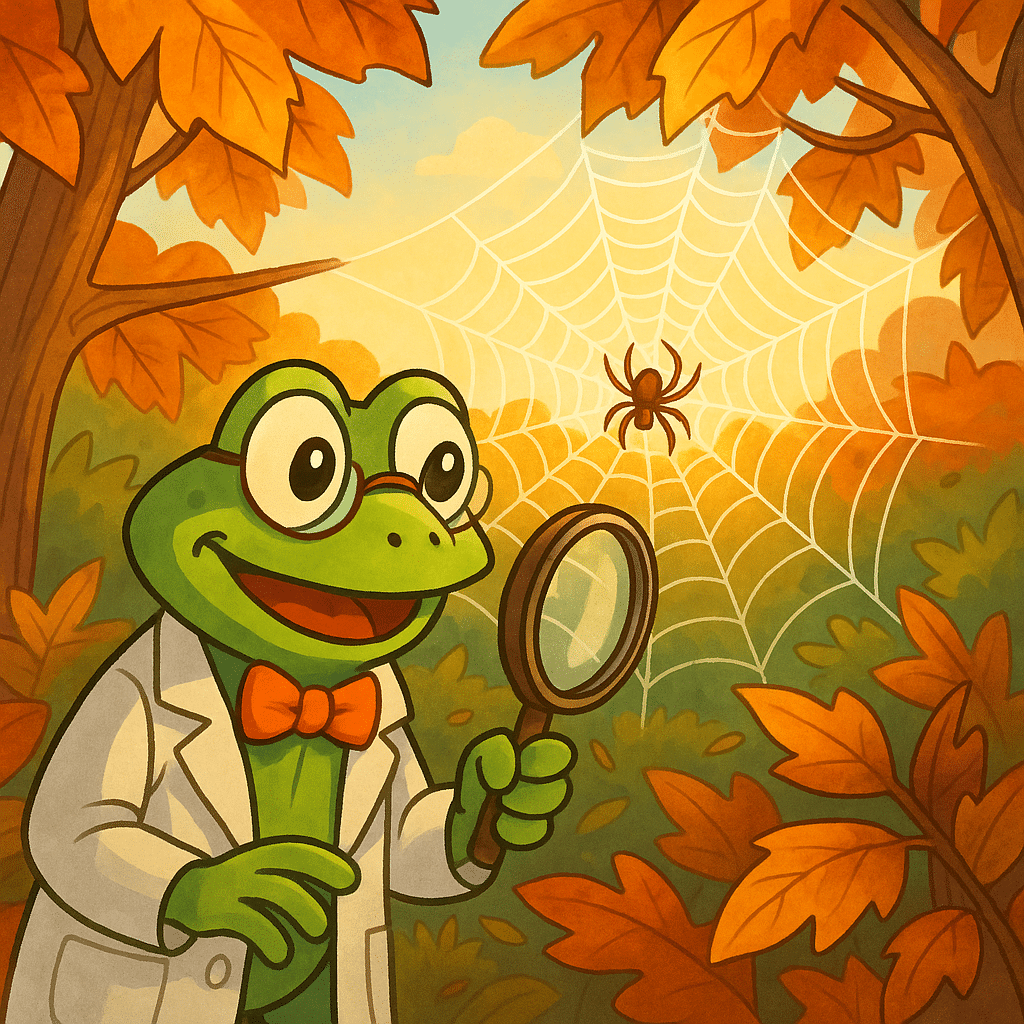
By Professor Bubbles, your frog scientist who loves exploring nature’s clever designs! 🐸🔬
🍁 Spiders in Autumn
When autumn arrives, and the air turns cool and crisp, you might start noticing more spiderwebs glistening in the morning dew.
They sparkle in the sunshine, stretch between bushes and fences, and sometimes even decorate your window! 🌅✨
But why do spiders seem so busy in autumn?
And how do they make those perfect webs?
Let’s dive into the secret world of spiders with Professor Bubbles! 🐸🔍
🕸️ Web-Building 101: How Spiders Make Their Webs
Spiders are engineers of nature.
They use silk from special glands in their bodies to build webs that are strong, sticky, and flexible.
Here’s how it happens step by step:
- Anchor: The spider releases a silk thread that catches onto a nearby branch or wall.
- Frame: It walks across to create the outer edges of the web.
- Spokes: The spider spins lines from the center outward — like the spokes of a bicycle wheel.
- Spiral: Finally, it adds a sticky spiral that catches insects for dinner. 🪰
“A spider web is like a trampoline, a fishing net, and a science project all in one!”
— Professor Bubbles 🐸🕸️
🍂 Why Autumn Is the Season of Webs
Autumn is the spider’s busiest season!
That’s because:
- 🕷️ Many spiders hatch in spring and grow up by autumn — now they’re strong enough to spin big webs.
- 🌬️ Cool, still mornings make dew appear on webs, making them easier to spot.
- 🪲 Insects are still active, so there’s plenty of food to catch.
- 🏠 Spiders build webs near warm spots — like garden sheds, fences, and windows.
So, if you notice more webs in autumn, it’s not your imagination — it’s spider season! 🕸️🍁
🧪 Try This Fun Spider Science Activity
Make a Spider Web Finder!
You’ll Need:
- A flashlight or phone light
- A spray bottle with water
- A notebook and pencil
Steps:
- Go outside early in the morning or before sunset.
- Shine your light through bushes or fences.
- Lightly spray water mist into the air.
- Watch as hidden webs appear — sparkling in the light! ✨
Draw what you find! How big is the web? Is it round or messy?
You’ll be amazed how many spider homes are hiding in plain sight.
“You don’t need to catch spiders — just catch their science!”
— Professor Bubbles 🐸🔦
🧠 Fun Spider Facts
🕷️ A spider’s silk is stronger than steel (for its size).
🌈 Some spider silk can shine in UV light so birds can see and avoid flying into it.
🐸 Most spiders rebuild their webs every day!
🪰 Webs recycle — spiders eat old silk to save energy.
💨 A baby spider can fly on the wind using silk threads — this is called ballooning!
📚 Science Vocabulary
| Word | Meaning |
|---|---|
| Silk | A thin, strong thread made by spiders to build webs. |
| Predator | An animal that hunts and eats other animals. |
| Prey | The animal that is hunted (like insects). |
| Ballooning | When spiders use silk to catch the wind and travel far away. |
🌍 Why Spiders Matter
Spiders might look scary, but they’re heroes of the ecosystem! 🦸♀️🕷️
They eat mosquitoes, flies, and pests — keeping nature in balance.
Without spiders, we’d have too many bugs and fewer plants.
So next time you see a web, don’t knock it down — admire the masterpiece!
“A spider’s web is art, architecture, and science — all spun by nature’s engineers.”
— Professor Bubbles 🐸🕸️