

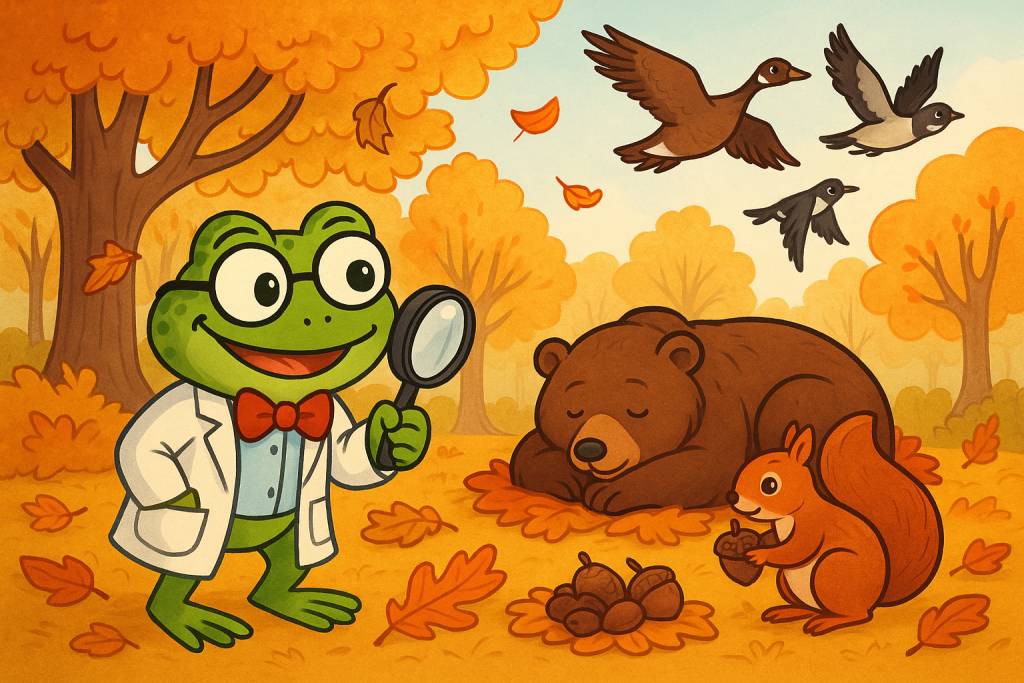
By Professor Bubbles, your frog scientist who loves watching animals get ready for the cold! 🐸❄️
🍁 Autumn: The Season of Preparation
When autumn arrives, nature begins to change — the air cools, leaves fall, and the days grow shorter. 🌳🍂
But while we humans put on warm sweaters and drink hot chocolate, animals all over the world start working hard to get ready for winter.
Some animals store food, some grow thicker fur, and others take a long nap until spring! 💤
Let’s explore the amazing ways animals survive the cold — with Professor Bubbles as our guide!
🐻 Hibernation: The Long Winter Nap
Some animals deal with winter by sleeping through it!
This special kind of deep sleep is called hibernation.
During hibernation, animals’ hearts beat slower, and their body temperature drops to save energy.
They survive by using the fat and food they stored during autumn.
Animals that hibernate:
- 🐻 Bears — they find cozy dens or caves to sleep in.
- 🦔 Hedgehogs — they curl up under leaves or logs.
- 🐸 Frogs (like me!) — we bury ourselves in mud to stay safe and warm.
- 🐢 Turtles — they sleep at the bottom of ponds.
“Hibernation is like hitting the pause button until spring sunshine returns!” — Professor Bubbles 🐸💤
🐿️ Food Storage: Nature’s Tiny Shoppers
Not every animal can hibernate — some stay awake and collect food instead!
Squirrels, mice, and birds gather nuts, seeds, and berries all autumn long. They hide them in safe places like tree holes, burrows, or under leaves. 🌰🍎
When winter comes and food is hard to find, they remember (most of!) their hiding spots.
Fun fact: Squirrels forget about a few nuts — and that’s how new trees grow in spring! 🌳🐿️
“When you see a busy squirrel, you’re watching a gardener planting the future forest!” — Professor Bubbles 🌰🌱
🦊 Changing Coats: Nature’s Winter Fashion Show
Many animals grow thicker fur in autumn to keep warm through winter.
Their bodies sense shorter days and cooler air, and start growing a cozy new coat.
Some even change color to blend in with the snow!
Examples:
- 🐇 Snowshoe hares turn from brown to white in winter.
- 🐺 Wolves and foxes grow thicker, fluffier fur.
- 🦉 Owls puff up their feathers to trap warm air.
It’s like nature gives them built-in winter jackets! 🧥❄️
🐦 Migration: Traveling to Warmer Places
Some animals don’t want to deal with the cold at all — so they fly away!
This journey is called migration, and it’s one of the most incredible natural events on Earth.
- 🐦 Swallows and storks fly south to find warm air and food.
- 🦋 Monarch butterflies travel thousands of kilometers to Mexico!
- 🐋 Whales swim to warmer oceans to raise their babies.
Animals use stars, sunlight, and even Earth’s magnetic field to find their way — no maps needed! 🧭🌍
“While we build fires and wear coats, animals use nature’s GPS!” — Professor Bubbles 🐸🗺️
🔬 The Science Behind It All
As days get shorter, animals notice changes in light and temperature.
Their brains send signals that it’s time to prepare:
- Eat more to store energy 🍽️
- Grow thicker fur or feathers 🧤
- Store food 🐿️
- Or get ready to sleep through winter 😴
It’s nature’s perfect survival system, ensuring that when spring returns, every animal is ready to wake up and start the cycle again. 🌸
🧪 Try This Fun Autumn Activity!
Build a Mini Animal Shelter 🏕️
You’ll Need:
- Sticks, leaves, and a small cardboard box
- A bit of moss or grass
- Imagination!
Steps:
- Go outside and gather natural materials.
- Build a “winter home” for a pretend animal (like a hedgehog or mouse).
- Talk about what animals need to stay warm and safe.
- Leave it outside and see if a real critter visits! 🦔🌿
🧠 Fun Facts from Professor Bubbles
🐦 The Arctic tern flies from the North Pole to the South Pole — over 30,000 km each year!
🐻 A bear’s heart rate can drop from 60 beats per minute to 8 during hibernation.
🐿️ Squirrels can bury up to 5,000 nuts in one autumn!
🐸 Frogs can survive being frozen — and thaw out again in spring!
📚 Science Vocabulary
| Word | Meaning |
|---|---|
| Hibernation | Deep sleep that helps animals survive the winter. |
| Migration | Traveling from one place to another with the seasons. |
| Adaptation | A change that helps an animal survive in its environment. |
| Instinct | A natural behavior that animals are born with. |