

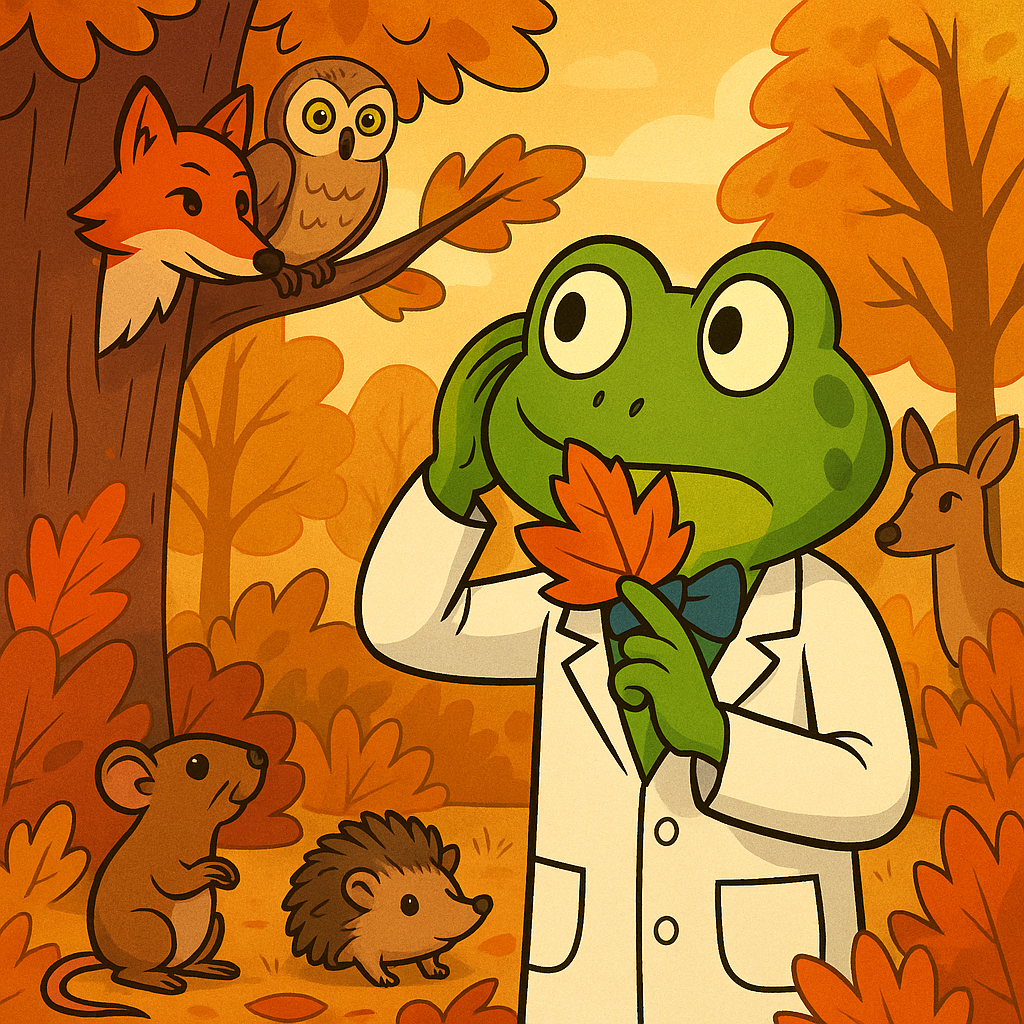
By Professor Bubbles — the frog scientist with super sniffing skills! 🐸👃✨
🍁 Autumn Is a Season Full of Signals
When autumn arrives, nature becomes a playground of new smells, sounds, and textures.
Animals must use their super senses to find food, stay safe, and prepare for winter.
Humans have five senses…
but animals often have supercharged versions that help them survive in incredible ways.
Let’s explore how different creatures use their senses in autumn — with Professor Bubbles as our guide!
👃 The Amazing Sense of Smell
🦊 Foxes
Foxes rely on their noses more than their eyes.
In autumn, fallen leaves hide animals like mice — but foxes can smell them through layers of soil and plants.
Their noses help them:
- Find prey
- Locate hidden nuts
- Sense danger
🐻 Bears
Bears have one of the best noses on the planet — they can smell food from kilometers away.
In autumn, they search for berries, honey, and seeds to build fat stores for hibernation.
👂 Super Hearing
🦉 Owls
Owls are autumn’s silent hunters.
Their hearing is so sharp that they can detect the tiny sound of a mouse moving under leaves.
Some owls even have asymmetrical ears — one higher than the other — to pinpoint exactly where the sound is coming from.
“Owls have better hearing than frogs… and that’s saying something!”
— Professor Bubbles 🐸👂
👀 Night Vision in the Autumn Darkness
Shorter days mean longer nights — perfect for animals who see in low light.
🦌 Deer
Deer have large eyes that let in more light, giving them excellent night vision.
This helps them move safely through forests at dusk and dawn.
🦨 Hedgehogs
Hedgehogs come out at night, sniffing for insects and worms.
Their eyes aren’t the strongest, but their sense of smell and hearing make up for it!
✨ Touch and Vibration
🕷️ Spiders
Spiders don’t see very well, but their webs act like vibration sensors.
If an insect touches a single strand, the spider feels the vibration instantly — even from far away.
In autumn, when many insects are still active, spiders rely heavily on this sense to find food.
🐸 Frogs
Frogs like Professor Bubbles feel vibrations through the ground.
This helps them detect approaching animals, rain, or other frogs calling.
🥜 Taste and Food Detection
🐿️ Squirrels
Squirrels taste-test acorns to decide which ones to eat now and which to store for winter.
They can detect bitterness, which tells them if an acorn will spoil.
🦤 Birds
Birds use taste to choose ripe berries.
In autumn, berry bushes are full — and birds help spread seeds far and wide.
🧪 Try This Fun Autumn Activity!
“Animal Sense Challenge”
You’ll Need:
- A blindfold
- Leaves
- Pinecones
- Nuts
- A helper
Steps:
- Blindfold the player.
- Let them guess objects using touch, smell, or sound.
- Discuss which animals rely on that sense in autumn.
Kids love this sensory science game — and it teaches how animals explore the world!
🧠 Fun Facts From Professor Bubbles
👃 A bear’s nose is 100× stronger than a human’s.
👂 Owls can hear a mouse’s heartbeat from far away.
👀 Cats’ pupils widen in autumn twilight for better night vision.
🕷️ Spiderweb silk carries vibrations like a guitar string.
🐦 Birds see more colors than humans — including UV!
📚 Science Vocabulary
| Word | Meaning |
|---|---|
| Vibration | Movement that travels through air or surfaces. |
| Nocturnal | Active at night. |
| Hibernation | A long, deep winter sleep. |
| Instinct | A behavior animals are born knowing how to do. |